Covering Islam by Edward Said
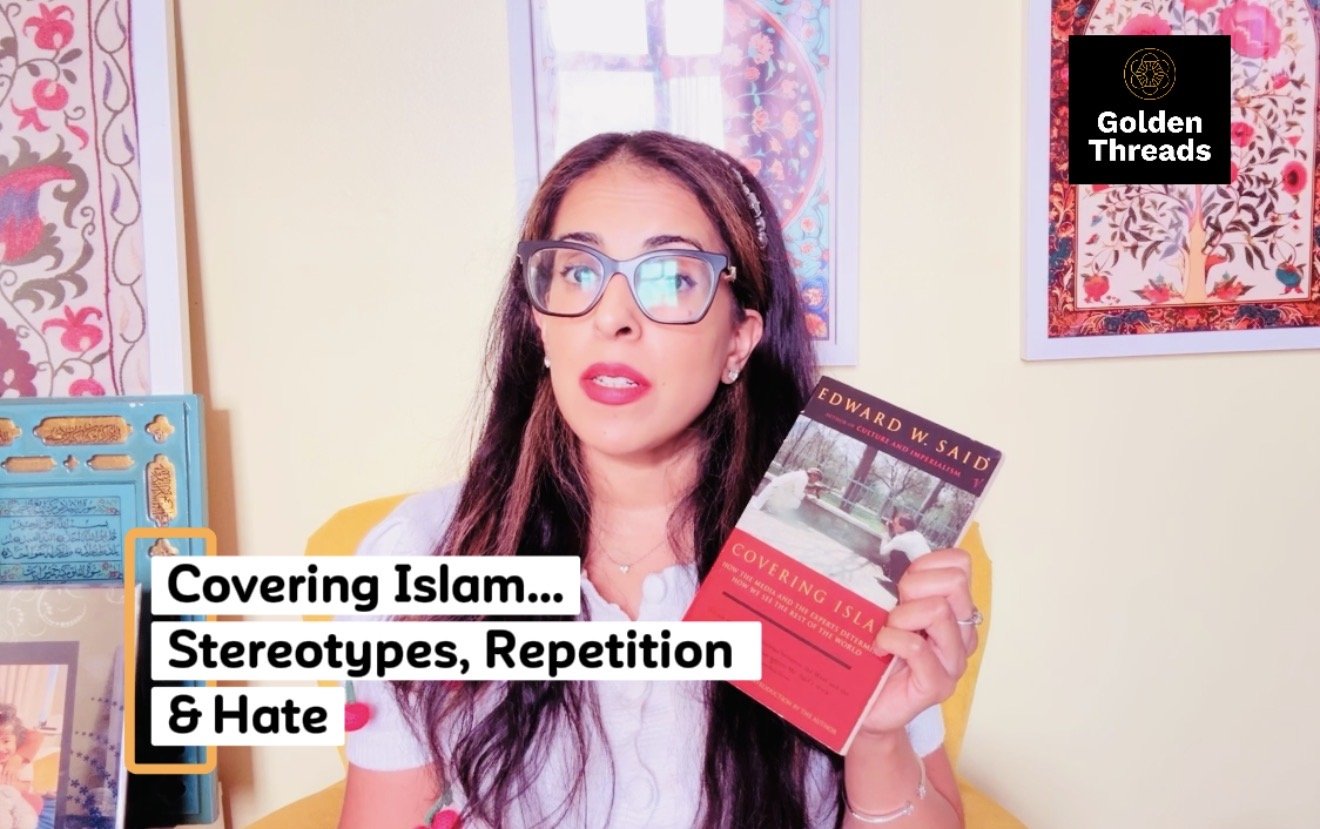
Edward Said’s book, ‘Covering Islam’ builds on his seminal work ‘Orientalism’ showing how nineteenth century negative tropes about Islam have continued into the modern age in the form of media, film and television representation.
The revised edition written in 1997 continues to show that much in the depiction and coverage of Muslims remains unchanged.
Orientalism is what Said termed as a system of knowledge and representation through which the West constructed “the Orient” as fundamentally different and inferior, closely bound up with imperial power.
The Muslim and ‘Arab’ waa portrayed as uncivilised, barbaric, licentious, perverted and uncouth amongst other negative analogies.
As cinema and television became mass forms of entertainment in the U.S, Hollywood translated these existing Muslim portrayals onto the big screen- and these stereotypes became entertainment.
Covering Islam highlights how this representation of Muslims continues in western media, film and society all the way to present day. Said says: “Muslims are uniformly represented as evil, violent, and above all, eminently killable. One of the changes from an old habit of exotic the Orient in Hollywood films is that romance and charm have now been completely eliminated.”
These previous representations of Muslims through film and entertainment paved a smooth pathway for negative and believable media stories portraying Muslims in a bad light- and as terrorists, because audiences were already familiar with the narrative.
Suiting a U.S. policy, these representations serve or reinforce Western geopolitical interests and existing power relationships.
Said writes that coverage of Islam in the west has “licensed not only patent inaccuracy but also expressions of unrestrained ethnocentrism, cultural and even racial hatred, deep yet paradoxically free-floating hostility.” He adds that is not the same in the depictions of Christianity or Judaism.
In the book, Said spends time focusing on academia and how it props up these attitudes creating a vicious circle. The teaching of Middle Eastern studies or Islam in U.S. universities is not without motive.
Said said that “virtually nothing about the study of Islam today is “free” and undetermined by urgent contemporary pressures. This is very far from the unpolitical objectivity alleged by many Orientalist scholars about their work.”
Said argues that even in well respected academic institutions like Princeton– there is a flawed perception of Muslims in the study of the Middle East. There is a one-sided portrayal of the negative aspects of Muslims and Islam. And when an academic work appears that challenges these Islamophobic tropes – it is not given the same platforms, and in time the work gets forgotten and buried. But it is the negative academic works that are profiled and promoted.
It’s a vicious circle. To be accepted in the academic circles and to get credibility, there is a need to go along with the status quo. It is acceptable to regurgitate Islamophobic tropes- the ones that challenge are labelled as inept or not genuinely scholarly.
With the constant news about Muslims, ‘Arabs,’ the Middle East and Iran - the media qualifies its coverage by the use of ‘Muslim’ and ‘Islam’ experts. These experts are found in the aforementioned academic institutions. These Islamophobic tropes are then rubber stamped and the mass public believe them because ‘experts’ are involved.
Said links all these elements together and states:
“The canonical, orthodox coverage of Islam that we find in the academy, in the government, and in the media is all interrelated…The success of this coverage can be attributed to the political influence of those people and institutions producing it rather than necessarily to truth or accuracy.”
Journalists – for example in America – cannot really be that independent because they are normally linked to some corporation or the other, and sometimes even with the government. Said states: “But in the end, because they are corporations serving and promoting a corporate identity – “America” and even “the West” – they all have the same central consensus in mind.”
Said’s argument is not that Muslims, Muslim-majority societies or Islam should be protected from criticism. It is that Muslims are extraordinarily diverse, yet Western political, academic and media institutions have repeatedly reduced that diversity to a narrow collection of recognisable types: the fanatic, the terrorist, the irrational believer, the threatening outsider.
The question, therefore, is not simply whether an individual newspaper article or film is accurate. It is about who has historically been given the authority to define Islam and Muslims, whose expertise is treated as credible, and why certain representations are repeated until they begin to appear self-evidently true.
This is what makes Covering Islam so relevant decades after it was first published. Said asks us to look beyond individual headlines and consider the wider system through which knowledge about Muslims is produced, legitimised and circulated. Once the same assumptions move between academia, government, journalism and popular culture, stereotypes no longer look like stereotypes. They begin to look like common sense.