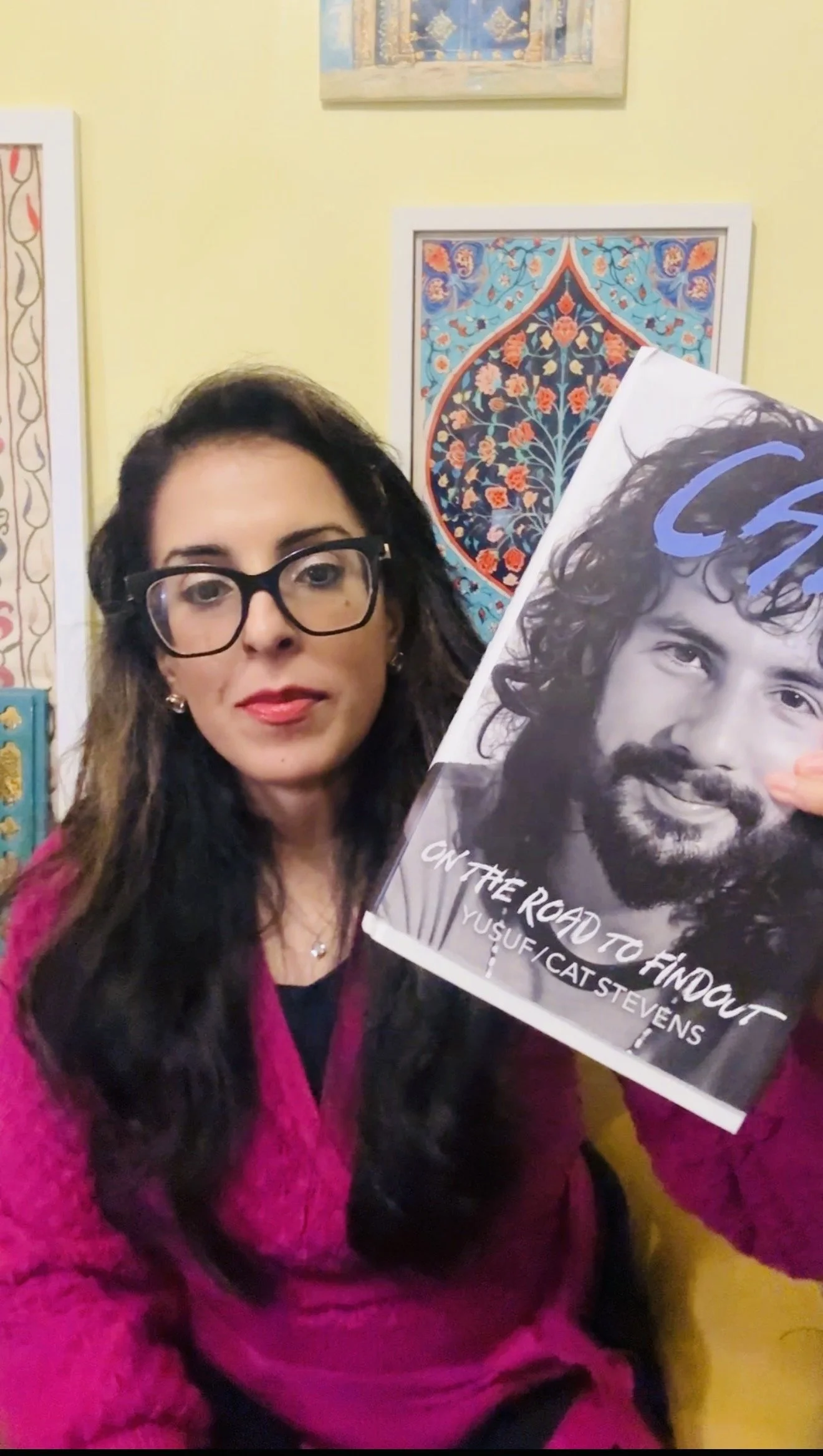
Review of ‘Cat on the Road to Find Out’ by Yusuf Cat Stevens
Amidst the fame and stardom of the trendy 1960s and 1970s, one of the era’s most eligible bachelors and pop star icons, made the mammoth decision to quit the music business and become Muslim.
Islam was not a popular choice of faith at the time. The world was in shock, as the pin-up pop star disposed of his fashionable look and public persona, and donned Muslim attire with a Muslim beard in tow. Although the beard wasn’t a far cry from the beard he wore as Cat Stevens - but it was now interpreted through a different lens.
Although the conversion took many by surprise, reading Yusuf’s story, it wasn’t really that much of a massive leap. There was always a sense of God in his life, and he was continually searching and questioning. He said: “I had always maintained a strong belief in God”
Growing up with a Greek Cypriot dad and Swedish mum, his formative years were living in the hustle and bustle of theatre land in Shaftesbury Avenue where his family owned a restaurant.
Faith at the heart
Although they weren’t Catholic, he was sent to Catholic school. In the book, Yusuf credits his faith schooling for giving him a foundation in faith and belief in God. And that is why he was convinced that faith-based schooling was very important for young people, and this led him to eventually set up the first Muslim state school in the UK.
Creative talents
Music came naturally to him, though he was largely self-taught. From childhood, he sketched constantly, created stories, and immersed himself in his own world. I didn’t know he designed many of his album covers himself.
He was in awe of the popular music scene, loved the Beatles and would listen to tracks in his room. Residing in Shaftesbury Avenue added to that sense of London glamour, and some of that stardust rubbed off on him. He began writing his own songs and learning guitar. His relentless efforts transformed him into a talented singer and songwriter whose music was loved and recognised worldwide. His lyrics drew on deeper meanings pondering the world around him. He particularly loved Bob Dylan’s conscious music stating that: “Words needed to mean something.”
The music business was intense, demanding and self-promoting. It inevitably led to being absorbed into a hedonistic lifestyle. This never sat well with him. He frowned at journalists’ shallow questions about his clothes and style. He found himself becoming increasingly arrogant and developing a superiority complex. He didn’t like what he was being moulded into. His belief in a higher power and meaning of life was the force that was pulling him away. He said: “Within my subconscious, I had always been aware that some ever-present power behind life was close, watching and overseeing.”
To live or die?
This famous lifestyle was fated to change. After three brushes with death, one as a youngster almost falling off a roof, contracting tuberculosis in 1968, and then almost drowning in the Pacific Ocean, were signs that he needed to alter his life path. When he thought he would drown, he made a promise to God that if He saved him, he would dedicate his life to the almighty. Yusuf said: “O God, if You save me, I’ll work for You!”
And that declaration led him to Islam. After being gifted the Qur’an by his brother David, Yusuf was soothed and transformed by its message. He took a trip to the Dome of the Rock mosque in Jerusalem and decided there that he was a Muslim. In 1977, he took his shahada - the formal declaration of faith.
Islam and its demonisation
Although searching for something, he never considered Islam an option because of the overwhelming sense of negativity surrounding the religion. He said: “There was a natural aversion I had to things connected with my father’s longtime enemies, the Turks. Also, the image of Arabs was really not much better; Lawrence of Arabia, starring Peter O’Toole, left a recent imprint from a slice of Arab history that only reaffirmed the superiority of Western military intelligence and tactics over the tribal desert dwellers and fractured Arab nations.”
It didn’t help with the media and politicians fuelling anti-Muslim hate. He said that when approaching the Qur’an: “I had a job to break through general negative attitudes, built up over years of absorbing reporting on Muslims.”
He credits God for helping him see beyond the anti-Muslim narrative: “Had it not been for the intervention of God, sending me the Qur’an… I would have likely joined the majority of critics and branded the religion as regressive.”
It was unsavoury Muslims like Saddam Hussein who dominated the headlines, which consistently painted a bad image of Islam. He expresses annoyance at this, and that the peace and spirituality of Islam was completely erased. Why weren’t inspiring Muslims like Charles le Gai Eaton (a former British diplomat and editor who had written profoundly spiritual books in Islam) profiled and promoted he exclaimed.
Yusuf Islam: Faith, Resistance, and the Soundtrack of a Generation
When he converted to Islam, it was the story of Joseph (Yusuf) in the Qur’an that captured his heart. He fell deeply in love with the narrative—its themes of betrayal, patience, exile, forgiveness, and ultimate return. Yusuf saw echoes of himself in the story, and when he chose his new name, it felt inevitable.
He became Yusuf Islam - a name that reflected not only faith, but belonging. And he wrote: “My soul had found its home, at last.” Central to his conviction was the belief that the Qur’an could not be human-authored. To him, it was unmistakably “a message from my Maker.”
Becoming Muslim; Becoming ‘Other’
“Almost immediately after embracing Islam, Yusuf sensed a profound shift in how the world saw him - despite his white European heritage. He said: “My situation altered drastically; from being one of the white(-ish) majority, I was now one of an increasingly identifiable minority.””
This transformation unfolded against a backdrop of escalating global hostility toward Muslims. The Cold War spilled into Afghanistan. The United States and Saudi Arabia funded the mujahideen, with direct CIA involvement that would later entangle figures like Osama bin Laden.
Gone were the days when Yusuf could quietly study the Qur’an with his guitar beside him. “Now, my front door and the walls of my home were shaking from events happening outside it.”
This was long before 9/11. Anti-Muslim discrimination was already pervasive - fuelled by the Iranian Revolution, the Salman Rushdie affair, the invasions of Afghanistan and Iraq, and the horrific genocide of Bosnian Muslims. Islam was increasingly framed through a militant, dehumanised lens.
Yusuf observed: “Above the increasing noise of gunfire and visions of war raging in Muslim countries, I knew that people had little or no information to help them look objectively and access the true meaning of Islam from a spiritual perspective.”
Education as Resistance
In 1980, Yusuf’s first child Hasanah was born. Fatherhood sharpened his concerns about the future.“Due to the ever-increasing encroachment of the atheistic view of life, colonialising every inch of the curriculum, we needed to find a spiritually robust alternative.”
Around this time, he composed “A Is for Allah”—a song that would become foundational to the childhoods of countless Muslim children in Britain, including my own. That moment sparked a larger calling: the creation of a Muslim school, and a public effort to present Islam and Muslims positively in British society.
Founding Islamia - Against all Odds
The resistance was immense. Despite the existence of Jewish and Christian faith schools, institutional Islamophobia made the idea of a Muslim school controversial, even threatening. Yusuf focused on housing the school in Brent, a borough with a large Muslim population.
At the time, Margaret Thatcher was Prime Minister, and education cuts loomed. Government support for non-Christian faith schools was far from guaranteed. “There were already thousands of Church of England government-funded schools, as well as schools for the Catholic and Jewish communities, so why not us?”
“Legally, the 1944 Education Act allowed it, but the Muslim community had never successfully pursued this path before. Officials were openly hostile. “Trying to explain that concept to a dedicated and committed religious skeptic working in the council planning or education department was going to be one sizzling hell of a test.””
Opposition came from every direction: politicians, academics, secular lobbyists, local councillors, planners, even the fire brigade. Yet despite it all, Islamia Primary School opened its doors on Friday, 21 October 1983. Two of its first pupils were Yusuf’s daughters, Hasanah and Asmaa.
In 1999, Islamia gained grant-maintained status. In 2000, it received an official visit from Prince Charles who said: “I’m one of those who happen to believe there is no incompatibility between community-based activity… you are ambassadors for a sometimes much misunderstood faith… I believe that Islam has much to teach in increasingly secular societies like ours in Britain.”
Music, Faith, and Moral Complexity
After converting, Yusuf stepped away from music entirely. The issue felt unclear to him Islamically, a grey area he didn’t want to risk dabbling in. He gave away all his instruments, which were auctioned for charity- raising £40,000.
His spiritual mentor, Dr Darsh of Regent’s Park Mosque, viewed music as a matter of fiqh (contextual jurisprudence), not a fixed article of faith. Other scholars had different opinions. Yusuf studied deeply, reflecting over many years.
Eventually, he reached his own conclusion: “I believe that true Islam…allows for significant flexibility where the harmony of coexistence, peace, and saving of lives is concerned.”
He observed that music is woven into creation itself: “Nature has its own magnificent songs in praise of the Creator… birds sing, seas crash, winds whistle; stars and planets hum and hearts beat-it is all music of one kind or another.”
There is no verse in the Qur’an that explicitly mentions “music” as a generic concept - largely because no such term exists in classical Arabic. Yusuf also found numerous authenticated hadith showing the Prophet Muhammad’s allowance for song and musical expression on certain occasions.
“The issue of music was not as black and white as it was boldly pointed out to be by certain objectors just after I had entered through the door of Islam.”
Legacy
Decades later, Yusuf returned to music - gradually at first, then with full mainstream albums that were warmly received by Muslims and non-Muslims alike. His cultural impact in countering Islamophobia and humanising Muslims is immeasurable.
Even during his musical silence, his charitable and educational work spoke volumes. For many of us, Yusuf Islam was a visible, grounded leader during some of the most toxic years for Muslims in Britain. His Muslim songs formed the soundtrack of my childhood. His example showed us what principled, compassionate leadership looked like.
That legacy endures- and it deserves to be remembered with clarity, gratitude, and honesty.